Encryption: the Key to Success to Navigate the Complexities of Data Security in Healthcare
The Backstory: Why Encryption Has Become Vital for Digital Medical Applications
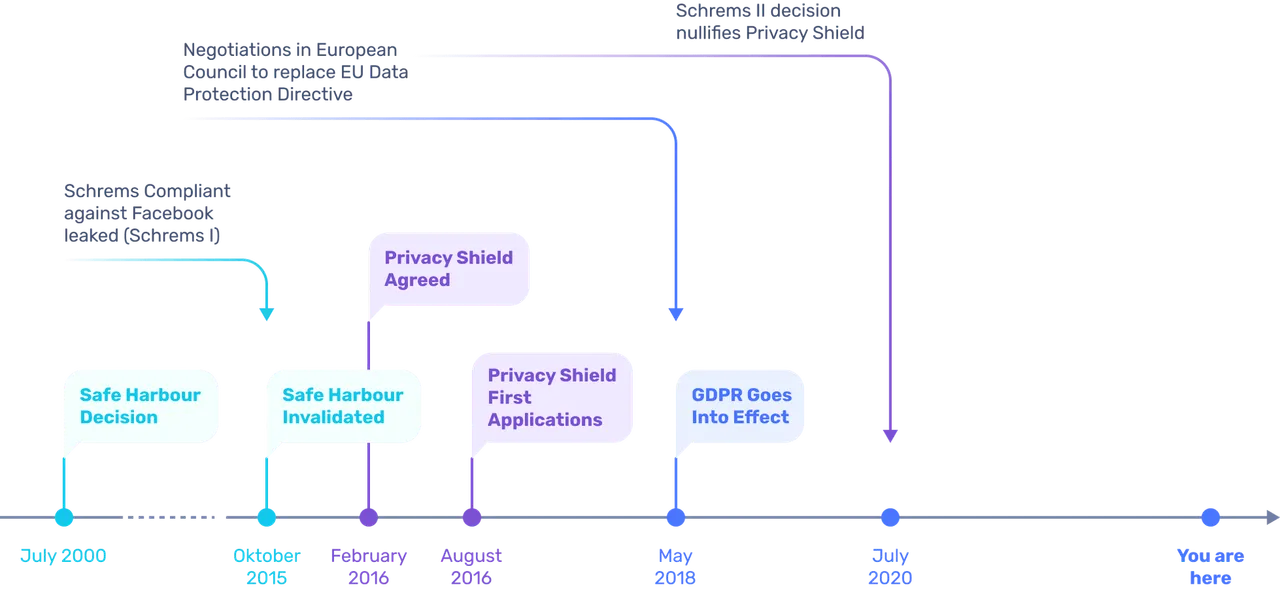
The Schrems II ruling and its Implications for Healthcare
The Schrems II ruling has significantly impacted the data protection landscape, undermining the EU–US Privacy Shield framework. This development has raised concerns about adequate data protection measures for patient information. Despite commendable efforts by U.S. medtech companies, challenges posed by U.S. surveillance laws continue to create obstacles in achieving GDPR and HIPAA compliance.
Adopting Standard Contractual Clauses (SCCs) and server location strategies
Companies in the U.S. and beyond have begun using Standard Contractual Clauses (SCCs) in contracts and strategically selecting server locations, such as establishing branches in Europe or partnering with cloud providers operating EU servers. While this represents progress, ambiguity persists due to U.S. ownership and potential data access requests by U.S. authorities in healthcare contexts.
The Trans-Atlantic Data Privacy Framework: a ray of hope
The March 2022 announcement of the Trans-Atlantic Data Privacy Framework by the European Commission and the U.S. represents progress. However, the absence of a concrete adequacy decision leaves the current situation uncertain. The complex nature of trans-continental data privacy negotiations in the highly regulated healthcare sector indicates comprehensive solutions will require time.
Data protection is not black and white - The Doctolib Ruling (France)
The Doctolib ruling in France underscores the significance of “sufficient safeguards” in healthcare. This ruling emphasizes how legal and technical measures, including encryption and key management, play pivotal roles in ensuring data protection. The court’s favorable decision highlights the importance of these safeguards, even when hosted by U.S.-based providers like AWS.
The Basics: Diving Deeper into the World of Encryption
Importance of Encryption in the Healthcare Industry
Healthcare has become one of the most data-intensive industries, generating and storing vast amounts of patient information. Approximately 30% of the world’s data volume originates from the healthcare industry. Safeguards, including encryption, are critical for protecting patient information from unauthorized access due to growing data breach incidents.
Why Do We Need Encryption?
Confidentiality: Prevents unauthorized access to sensitive information, ensuring only authorized users can view it.
Security: Encryption helps protect data from theft or hacking, making it more difficult for attackers to access and steal sensitive information, thus improving data security.
Compliance: In many industries, data encryption is a requirement to meet regulations, such as HIPAA for healthcare.
Privacy: Encrypting data protects personal information, such as health records, from being accessed or used without permission.
Trust: Encryption helps build trust between organizations, customers, and partners by demonstrating commitment to protect sensitive information.
Authentication: Through digital signatures, digital certificates, or a Public Key Infrastructure.
Top 5 Use Cases of Data Encryption in Healthcare
Electronic Health Records (EHRs): Protecting comprehensive patient records from unauthorized access.
Medical Devices: Securing data transmitted between connected medical equipment like insulin pumps and pacemakers.
Remote Patient Monitoring (RPM): Ensuring the confidentiality of vital signs and health data outside traditional healthcare settings.
Telemonitoring: Safeguarding data transmitted during telehealth sessions, maintaining patient information confidentiality.
Healthcare Data Analytics: Protecting large sets of healthcare data used for insights into patient health and healthcare operations.
Some of the Healthcare Related Standards Referring to Encryption
HIPAA Requirements: Mandates encryption to protect ePHI during storage or transmission.
GDPR Requirements: While GDPR doesn’t explicitly mention encryption, it emphasizes enforcing security measures, with encryption considered an “appropriate technical and organizational measure.”
ISO27001: Emphasizes encrypting data as a critical control for ensuring confidentiality, integrity, and availability of information.
ISO27701: Provides a cryptographic framework for organizations, emphasizing policy on cryptographic controls and key management.
Country-Specific Regulations
DIGA (Germany): Elevating Data Security Through Comprehensive Measures
In Germany, the Digital Health Applications (DiGA) regulations set forth stringent requirements for safeguarding health data. Beyond standard practices, DiGA mandates implementation of an Information Security Management System (ISMS), ensuring comprehensive strategy for managing sensitive health information. DiGA places significant emphasis on encryption as a fundamental component of its data security framework.
HDS (France): Upholding Rigorous Standards for Personal Health Data Protection
In France, the Hébergeurs de Données de Santé (HDS) certification is pivotal in the nation’s healthcare data landscape. This certification mandates strong measures for securing personal health data. In alignment with broader data protection principles, HDS emphasizes encryption as a non-negotiable aspect of its certification requirements.
Proposing a Better Option for Addressing Healthcare Data Security Challenges: The Extra Horizon Option
Extra Horizon offers three advantages over alternative approaches: usage of EU-based storage locations, cluster-level encryption inclusion, and safe key management integration.
| Provider | Advantages | Disadvantages |
|---|---|---|
| Extra Horizon | EU-based storage locations; Cluster-level encryption included; Safe key management included | — |
| US Cloud Providers | Familiarity with established providers | Need to manage technical safeguards independently, including encryption and key management |
| EU Cloud Providers | — | Limited availability and maturity compared to U.S. providers; Need to manage technical safeguards independently, especially encryption and key management |
Conclusion
This article provides a comprehensive exploration into encryption’s critical role in healthcare and medtech. From examining legal implications like the Schrems II ruling to highlighting pivotal cases such as the Doctolib ruling, it navigates the intricate web of data security challenges.
Extra Horizon stands as a security solution, offering tailored approaches that leverage EU-based storage locations, cluster-level encryption, and safe key management. In the highly regulated and data-intensive healthcare sector, ensuring confidentiality, integrity, and availability of information remains a core commitment.