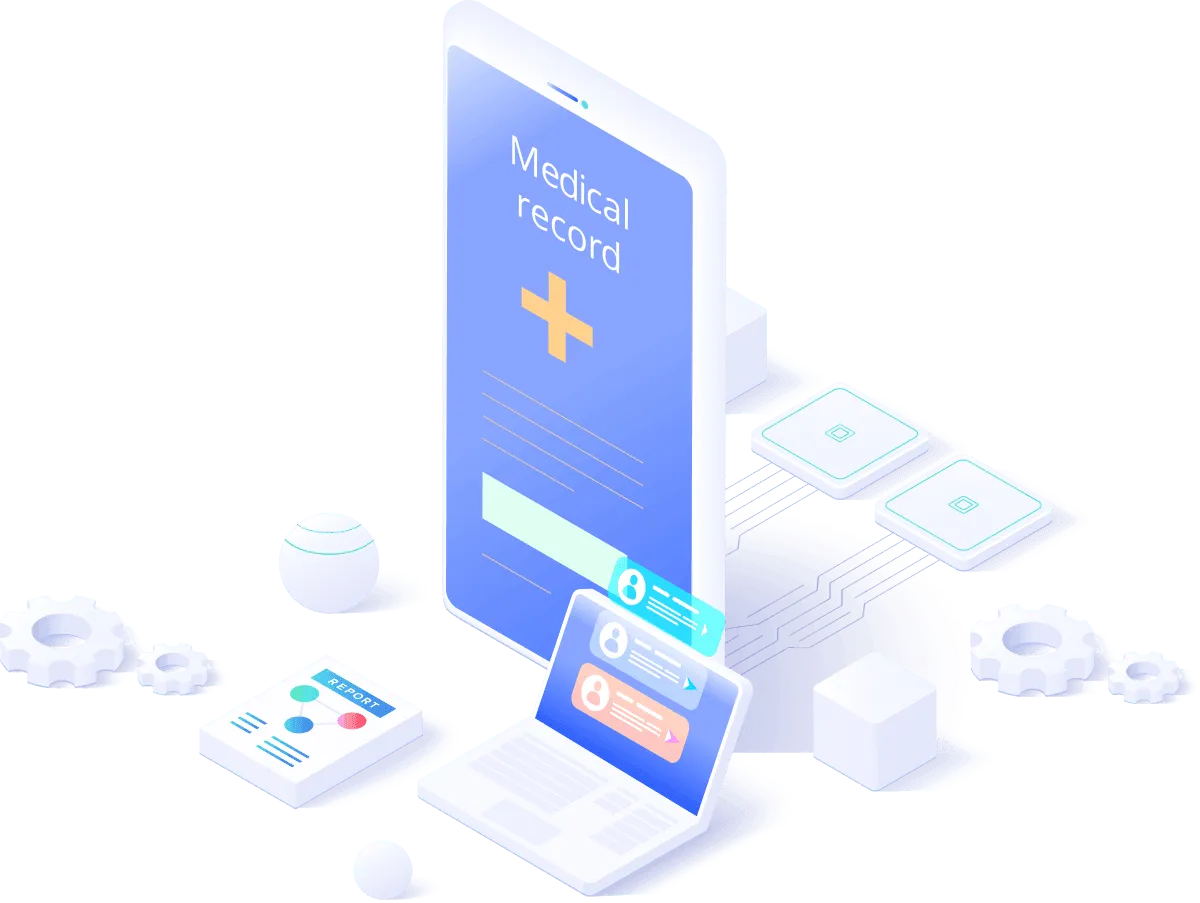
Why connecting Electronic Health Record (EHR) solutions with a medical cloud backend will be the future of centralised digital healthcare
What is an Electronic Health Record (EHR)?
An Electronic Health Record (EHR) is a digital version of a person’s medical record. EHRs make it easier and quicker for authorised users to access a patient’s medical information, and they are widely used in the healthcare world.
There are many different EHR systems available, and the system used can differ from hospital to hospital. The main challenge in the MedTech world is to make sure that EHR information can be exchanged easily between these different EHR systems.
An EHR may contain a number of different kinds of health information, including, but not limited to:
- A patient’s medical history and diagnoses
- Medications
- Treatment plans
- Immunisation dates
- Radiology images
- Laboratory results
- Allergy details
What are the benefits of Electronic Health Records (EHRs)?
Electronic Health Records (EHRs) offer considerable benefits to patients, clinicians, healthcare professionals (HCPs), and researchers. They allow clinicians to access a patient’s medical record quickly and easily, which leads to more efficient care, particularly in emergencies. Information can also be exchanged between different clinicians in real time, ensuring that all doctors and specialists have access to an accurate, up-to-date medical record for their patient.
EHRs also provide easy access to health analytics, which help clinicians recognise any patterns, thus helping them provide a diagnosis and recommend suitable treatment options. The same health analytics can also be used to track treatment progress as time goes on.
The historical medical information available in EHRs can also be very valuable for the further clinical development of therapies, as EHRs are a source of Real World Data (RWD)/Real World Evidence (RWE). This data can then be used to help design new clinical trials, and therefore develop new, innovative treatments for patients.
New legislation surrounding Electronic Health Records (EHRs)
On 3rd May 2022, the European Commission published a draft regulation for a European Health Data Space, which includes new rules about the use of EHRs. The European Health Data Space is a health-specific ecosystem of rules, common standards, infrastructures and governance framework that aims to strengthen links between national healthcare systems by means of secure and efficient access and exchange of health data.
What are the main interoperability challenges faced in the EHR field?
One of the main and frequently-discussed topics within the EHR field is the issue with interoperability. Interoperability means the ability of different information systems to access, exchange, integrate and cooperatively use data in a coordinated manner, within and across organisational, regional, and national boundaries.
The first and foremost issue surrounding EHRs is that they do not (yet) interconnect with each other. This means that, for example, a patient will have to re-enter all of their information every time they visit a new hospital or specialist.
Also, since the recent explosion in the use of remote monitoring applications/Software as a Medical Device (SaMD), it has become increasingly necessary for HCPs to have access to this data in order to monitor their patients properly.
With EHRs, it is essential that patient health data is shared between different systems and healthcare providers in a secure and efficient manner. However, there are many different EHR systems out there, and the system used often differs from centre to centre, region to region, or country to country.
Tackling interoperability with Fast Healthcare Interoperability Resources (FHIR)
A solution for tackling interoperability issues with EHRs is using Fast Healthcare Interoperability Resources (FHIR). FHIR is a standard that defines exactly how healthcare information can be exchanged between different systems, regardless of how that information is stored in those systems. It allows healthcare information to be shared securely to those who need to access it. FHIRs also contain an application programming interface (API) for the exchange of EHR data.
The FHIR standard was created in response to an increasing need for faster and easier methods to exchange data, especially due to the rapidly increasing amount of data in the healthcare space. Additionally, as the use of medical applications has become more and more commonplace, it has created the need for clinicians and patients to be able to share health data in an easy, real-time fashion.
So, how do FHIRs help solve this issue?
FHIRs act as a link between platform users and EHR systems, allowing the exchange of health data between different and dissimilar EHR systems. FHIRs reduce the issues surrounding interoperability, as they save the hassle of creating all of these integrations yourself by providing a readily-available link between different EHR platforms.
At Extra Horizon, we have an extensive knowledge of FHIR and EHR integrations. Leveraging our existing knowledge will save you the significant time and money it would take to figure everything out yourself.
The FAIR data principles and EHRs
Another significant challenge is the FAIR data principle. Indicated by its name, the FAIR principle states that all research objects should be:
- Findable
- Accessible
- Interoperable
- Reusable
The FAIR principles were created to encourage the use of the large number of patient registries and administrative databases. Using a medical cloud backend for EHRs can help significantly with meeting the FAIR principles, particularly the accessibility and interoperability elements.
So, how can a cloud-based Medical Backend-as-a-Service be useful when it comes to EHRs?
EHR systems generally fit into one of two categories; client-server systems or cloud-based systems. With client-server systems, data is stored on in-house servers, and clients communicate with the servers through a computer network. With cloud-based systems, data is stored on external servers, and any authorised user can access the data through the internet on their own device.
Although client-server systems were popular in the past, medical providers are now increasingly opting for cloud-based systems for storing their EHRs.
1. EHRs with cloud-based systems are easier to implement
Unlike client-server systems, cloud-based systems do not require the installation of hardware and software on-site. This makes implementation both faster and easier.
2. Cloud-based EHRs come with reduced costs
As no physical hardware or software needs to be installed for cloud-based systems, this saves you significant amounts of money in installation costs. Cloud-based system providers also generally offer fixed monthly prices, so the costs are predictable with no hidden surprises.
3. Reduced workload
Using an external medical cloud backend provider means that many tasks, such as installing hardware and updating software, are outsourced to the medical backend provider. This significantly reduces the workload for your team.
4. EHRs with a cloud-based backend offer better scalability
Medical backends are highly flexible, and are able to deal with sudden changes with ease. As more patients join a medical facility, the medical backend can easily adapt to accommodate an increased number of users.
5. Cloud-based EHRs have better interoperability
Medical backends often have capabilities that allow different EHR systems to communicate with each other, thus enabling information to be shared across different centres.
6. Cloud-based EHRs offer stronger security
Cloud-based systems offer a high level of security, which is vital when it comes to EHRs. When using a cloud-based system, data is encrypted, meaning that the information cannot be read by anyone except the authorised users of the EHR system.
Additionally, using a cloud-based Medical Backend-as-a-Service for your EHR system means that all data is thoroughly backed up in several different locations, preventing data from being lost in emergencies.
To conclude
Although very valuable in the healthcare space, EHRs certainly don’t come without their challenges. However, by harnessing the power of a medical cloud backend, you will be able to overcome these challenges with ease. By leveraging our readily-available Medical BaaS, you will save yourself the headache of working out all of the EHR integrations, as well as overcoming the looming issue of interoperability.